

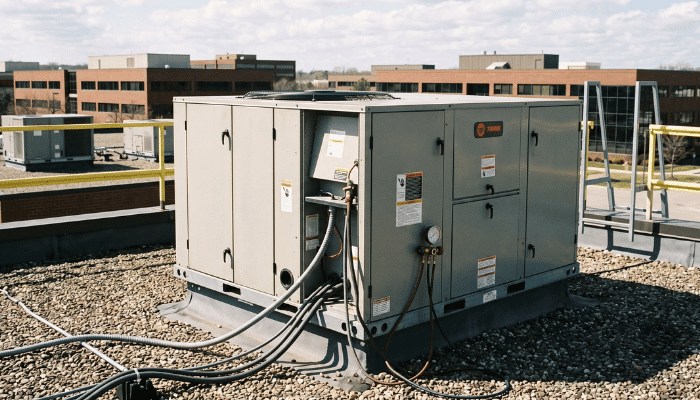
The Bottom Line: Maintained properly, a commercial HVAC system is a predictable operational asset; neglected, it becomes a major financial liability. Commercial heating, ventilation, and air conditioning maintenance naturally costs more than residential service due to equipment scale, system complexity, strict ventilation codes, and safety requirements. This guide outlines the concrete factors that drive commercial service investments and evaluates the bottom-line return on proactive facility care.
For any business managing a physical facility, managing overhead is a constant balancing act. When reviewing annual operating budgets, a commercial HVAC maintenance contract often stands out as a significant line item.
If you are accustomed to residential HVAC maintenance costs, the numbers on a commercial proposal can look surprising. It is natural to wonder why servicing a business environment requires a larger investment than servicing a home.
The price difference isn't a premium for the "commercial" label. Instead, it is driven by the physical scale of the equipment, the complexity of business building codes, and the high operational stakes of commercial downtime. Let's look at the specific factors behind these costs and evaluate the actual return on investment for a structured commercial service plan.
Why Commercial Maintenance Requires a Larger Investment
To understand the cost of a commercial agreement, it helps to look at how these systems differ from a standard home setup in design, placement, and operation.
1. Scale and Physical Capacity
A typical home relies on a system ranging from 2 to 5 tons in capacity. A light commercial property or office space easily utilizes systems starting at 10 to 30 tons, often split across multiple rooftop units (RTUs) or large-scale split systems.
More tonnage means larger coils, higher refrigerant volumes, and heavy-duty components. A routine task like changing filters or cleaning coils scales up exponentially. A single commercial facility may require dozens of specialized, heavy-duty filters and gallons of industrial coil cleaner per visit, driving up material costs.
2. Operational Intensity and Complexity
Residential units typically run intermittently based on the comfort preferences of a single family. Commercial systems, however, are subject to intense, continuous usage.
They operate for extended hours—sometimes 24/7 depending on the business type—handling high "occupant loads" (heat generated by employees, customers, computers, and lighting). Rather than a single thermostat on a wall, commercial layouts use complex economizers, automated fresh-air dampers, multi-zone VAV (Variable Air Volume) boxes, and integrated building management systems. Testing, calibrating, and balancing these components requires specialized diagnostic tools and significantly more time on-site from a technician.
3. Safety, Access, and Liability
Servicing a residential unit usually involves walking into a backyard or an attic with a step ladder. Servicing a commercial system often involves accessing a flat roof via security hatches, utilizing heavy extension ladders, or coordinating lifting equipment.
Working around high-voltage three-phase power, commercial exhaust fans, and structural roof perimeters requires strict adherence to OSHA safety guidelines. The insurance, training, and specialized certifications required for technicians to safely operate on commercial job sites naturally impact the baseline cost of professional labor.
4. Stricter Code and Ventilation Compliance
Unlike residential spaces, commercial buildings must strictly adhere to ventilation standards set by organizations like ASHRAE and OSHA. Commercial systems don't just cool the air; they are legally required to introduce a specific volume of outdoor fresh air to maintain indoor air quality and prevent CO2 buildup.
A standard maintenance visit includes inspecting and calibrating fresh air intakes, barometric relief dampers, and exhaust systems. Failing to maintain these components doesn't just cause discomfort—it can result in code violations or air quality liabilities for the business owner.
Why the Investment Is Worth It: The Commercial ROI
While the upfront cost of a commercial agreement is higher, the financial consequences of skipping maintenance are also exponentially higher for a business than a homeowner. Here is how a structured maintenance plan protects a business's bottom line:
Avoiding Costly Business Interruptions
If a residential air conditioner breaks down on a Tuesday morning, it's an inconvenience. If a commercial rooftop unit fails on a Tuesday morning, an entire office building loses productivity, a retail store loses foot traffic, or a restaurant loses inventory. In many industries, a single day of system downtime costs far more in lost revenue than an entire year of preventative maintenance.
Controlling Predictable Capital Expenditures
Commercial HVAC equipment represents a massive capital investment. A major failure—like a burned-out compressor on a 15-ton rooftop unit—can cost thousands of dollars in emergency repairs, crane rentals, and specialized labor. Proactive maintenance focuses on early detection, allowing facilities to replace a worn belt or a failing contactor for a nominal fee before it causes a catastrophic chain-reaction failure. This converts unpredictable emergency expenses into a steady, predictable operating budget — the same logic behind deciding when a repair still makes financial sense versus when it's time to replace.
Protecting Energy Budgets
Heating and cooling represent the single largest energy expense for most commercial properties. When coils become caked with dust, filters clog, or economizers stick open, the system has to draw significantly more power to meet demand. According to building performance data, routine cleaning and calibration can keep a system operating 10% to 20% more efficiently than a neglected unit — a pattern that shows up in available rebate and tax-credit programs tied to efficiency gains — translating directly into lower monthly utility overhead.
While residential systems generally require a single annual visit, a standard rule of thumb for commercial equipment is a minimum of two to four visits per year, depending on the business type. Retail spaces, offices, and restaurants experience high runtime and heavy filter loads, meaning quarterly filter changes and semi-annual deep cleans are usually necessary to prevent premature wear.
In-house teams are excellent for visual inspections and basic filter swaps if they have safe roof access. However, deep technical maintenance—such as checking refrigerant subcooling on a multi-stage system, measuring electrical draw on three-phase motors, or calibrating modulating dampers—requires EPA Section 608 certification, specialized diagnostic equipment, and advanced technical training. Missing small technical red flags can invalidate equipment warranties.
A professional commercial proposal should outline a clear checklist: comprehensive filter replacements, belt inspections and tension adjustments, electrical component testing (checking contactors and tightening terminals), condensate drain flushing, coil condition tracking, and a full operational check of the economizer and fresh air controls.