

Your AC quits on the hottest afternoon of the year. A technician comes out, finds the problem, and hands you a repair quote. Now, you’re stuck on the question every Alabama homeowner eventually faces: Do I pay to fix this thing one more time, or am I just throwing good money into a unit that's on its way out?
It's a stressful decision, and unfortunately, it's one where a homeowner can get steered the wrong way. Our job is to protect you from that—even when "repair" is the answer that earns us less today. Let’s walk through how to make this call, just as we would for our own family.
The 50% Rule: The Fastest Gut-Check
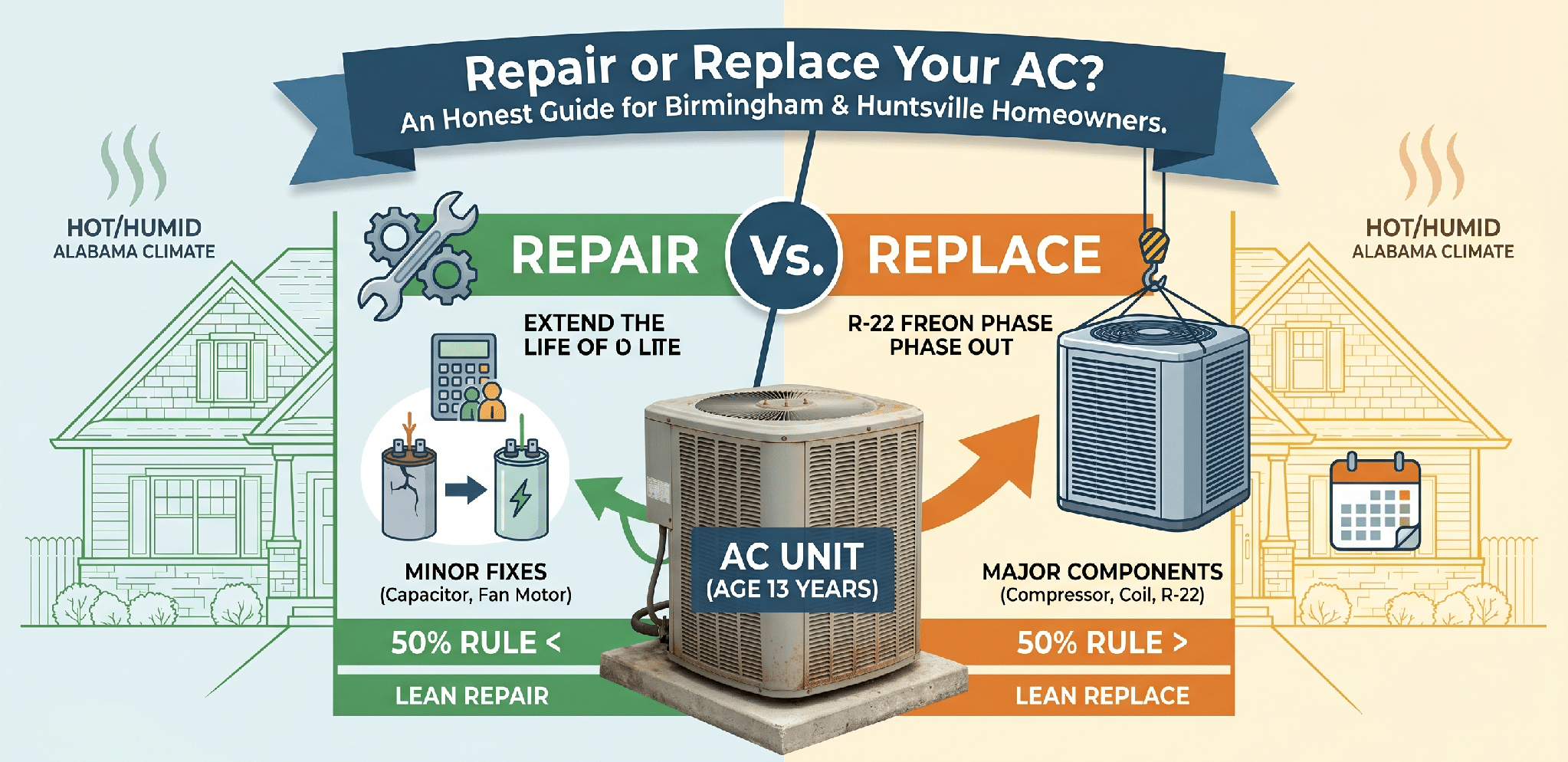
The simplest, most reliable starting point is the 50% rule. It works like this:
If a single repair costs more than half the price of a comparable new system, replacement is usually the smarter investment.
The logic is straightforward. Sinking $4,000 into a tired, 13-year-old unit doesn't reset its lifespan—you’ve spent a large chunk of replacement money and still own an old system that could fail again next summer.
Note: While this is a great starting point, our technicians often use an "Age x Repair Cost" formula internally. If that total is over $5,000, we find it almost always makes more sense to invest in a new system rather than holding onto an aging one.
Age Matters More in Alabama
A central air conditioner is generally built to last 10 to 15 years, but Alabama is anything but moderate. Here in Birmingham and Huntsville, our cooling season is brutal, long, and humid—often running six to seven months a year.
| Age of Unit | Recommendation |
|---|---|
| Under 10 Years | Lean toward repair. The unit likely has good years left. |
| 10 to 12 Years | The judgment zone. A minor repair is fine, but a major one tips toward replacement. |
| Over 12 Years | Lean toward replacement. You’re deep into borrowed time. |
Remember: This timeline shortens further if routine maintenance—like our Perfect Protection Plan—is skipped.
What Broke? Cheap Fixes vs. Major Repairs
Usually Worth Repairing
- Failed capacitor: One of the most common and cheapest fixes.
- Worn contactor or relay.
- Bad fan motor.
- Clogged drain line or tripped float switch.
Reasons to Consider Replacement
- Failed compressor: The heart of the system and one of the most expensive parts to replace.
- Leaking evaporator coil.
- Major refrigerant leak: Especially on older systems.
The R-22 Refrigerant Trap
If your AC was installed before roughly 2010, there is a strong chance it runs on R-22 (Freon). R-22 has been phased out and is no longer produced, making it extremely expensive. If your system needs a refrigerant recharge, the economics almost always point toward replacement rather than pouring premium-priced refrigerant into a system near the end of its run.
Still Unsure?
The honest truth is that every home is different. The most important step isn't reading a rule online—it's getting a straight, no-pressure diagnosis from a technician who will tell you the truth either way.
Need an honest, thorough evaluation?
Contact Perfect Service at 205-206-6091 or via our online contact form. We’ll tell you what actually failed and whether fixing it is the smart move—that's what protecting your home is supposed to look like.
It’s usually not the bargain it appears to be. A modern outdoor unit paired with an aging indoor coil often can’t perform as designed, can run less efficiently, and may create warranty complications.
Often, yes. A newer, properly sized unit usually runs more efficiently, though savings depend on your home, your usage, and how worn out your old system was.
Ask them to identify the specific part that failed and put the quote in writing. If they jump straight to "you need a new system" without diagnosing the failure, get a second opinion.