

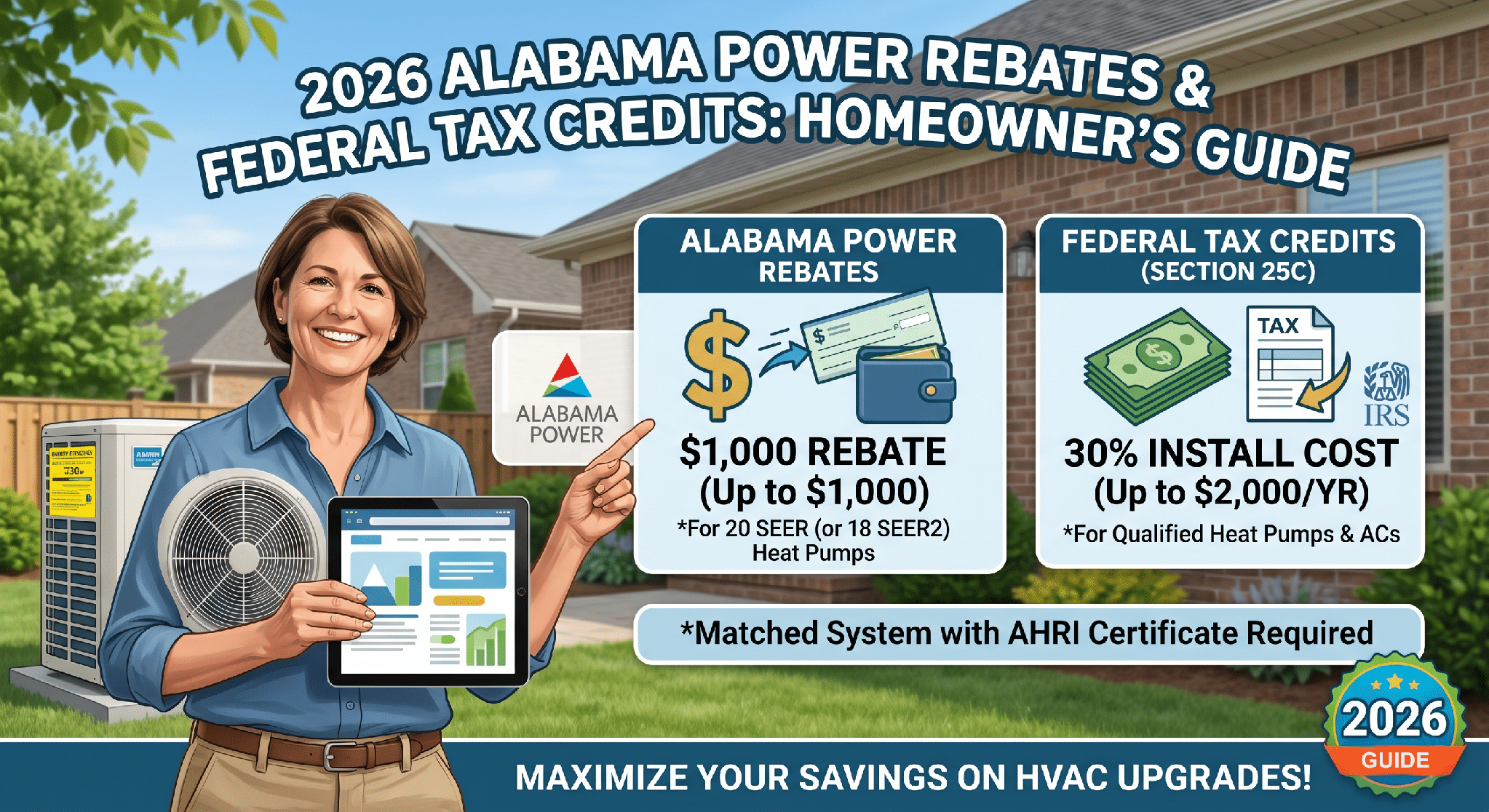
As of 2026, the main HVAC incentive available to Central Alabama homeowners is Alabama Power's $1,000 rebate for switching from a gas system to a qualifying high-efficiency heat pump — and that offer is scheduled to end December 1, 2026. The federal Section 25C tax credit that used to provide up to $2,000 is no longer available for systems installed in 2026; it expired at the end of 2025. Income-qualified households may also have a point-of-sale rebate coming through Alabama's HEAR program, though it had not yet launched at the time of writing.
If you're planning a new heating and cooling system, incentives are a natural part of the conversation — but the landscape shifted at the start of 2026, and a lot of older guides still online are now out of date. Here's an honest look at what's actually available in our market today, and how to qualify.
First, the Big Change: The Federal Tax Credit Ended in 2025
For several years, the federal Section 25C Energy Efficient Home Improvement Credit let homeowners claim up to $2,000 toward a qualifying heat pump and smaller amounts for high-efficiency air conditioners and furnaces. That credit expired for equipment placed in service after December 31, 2025.
What that means in plain terms: a system installed in 2026 does not qualify for the federal 25C credit. There's no grandfather clause based on when you signed a contract or paid a deposit — what matters is when the system is up and running.
There's one important exception. If your system was fully installed and operational by December 31, 2025, you can still claim the credit on your 2025 federal return (IRS Form 5695) when you file in early 2026. If that's you, hold onto your paperwork — more on that below.
What's Still on the Table: Alabama Power's $1,000 Heat Pump Rebate
The good news is that the strongest local incentive is still active — for now. Alabama Power offers a $1,000 rebate for residential customers who switch to a qualifying high-efficiency heat pump. The program is designed to reduce overall grid demand, so the requirements are set at a high efficiency bar.
Here's how it generally works:
- It's a fuel-switch incentive. The rebate is aimed at homeowners converting from a gas furnace to an all-electric heat pump. Homes that already run on an electric system typically won't qualify simply for upgrading to a newer electric unit.
- The efficiency bar is high. The installed heat pump generally needs to be rated 18 SEER2 (or 20 SEER) or higher.
- It must be the primary system. The qualifying unit has to be the dominant heating and cooling system in the home.
- Timing matters. Applications are generally submitted within 90 days of purchase, and Alabama Power reserves the right to inspect the installation to verify it matches the application.
- There's a deadline. This offer is currently set to end December 1, 2026, so there's a real window on it.
Income-Based Federal Rebates (HEAR): On the Way, Not Yet Live
You may also see mention of the federal Home Electrification and Appliance Rebates (HEAR) program — sometimes called HEEHRA. Unlike a tax credit, these are designed as direct, point-of-sale discounts for income-qualified households, based on your Area Median Income (AMI).
The catch in Alabama is timing: the state is still standing the program up, and it wasn't yet available to homeowners as of this writing. It's worth keeping on your radar, but it isn't something you can count on for a 2026 install just yet. We'll update this guide as the program goes live.
Keep Your Paperwork — Especially If You Installed in 2025
Whether you're filing for the 2025 federal credit or applying for the Alabama Power rebate, documentation is what makes or breaks the claim. Ask your installer for a detailed invoice showing the final paid amount and the specific model numbers of your indoor and outdoor equipment, plus the official AHRI Certified Matched System Certificate — the IRS and utility programs evaluate the complete matched system, not just the outdoor unit.
Because rebates reduce your effective price, they can also affect how any 2025 tax credit is calculated. Exactly how these programs interact with your personal finances is a question for a certified tax professional — we can handle the equipment and the paperwork, but your CPA should confirm what applies to your return.
Talk Through Your Options Before You Buy
Between a rebate with a deadline, a high efficiency bar, and the real cost of a new system, the smart move is to map out your options before you commit. We'll tell you honestly whether your project qualifies for the Alabama Power rebate, help you hit the efficiency requirements, and lay out financing for whatever's left.
Call Perfect Service at 205-206-6091 or contact us online and we'll walk you through what's available for your home.
No. Because federal tax credits are tied strictly to your personal tax return and annual liability, they cannot be deducted from an equipment invoice by a contractor. Determining exactly how a credit applies to your finances requires a review by a certified tax professional or CPA.
No. Alabama Power’s high-efficiency rebate requires a minimum rating of 18 SEER2 (or 20 SEER). It also requires meeting specific structural guidelines, such as an all-electric setup or a gas-to-electric conversion.
You will need a detailed invoice showing the final paid amount alongside the specific model numbers of the indoor and outdoor equipment. You should also request the official AHRI Certified Matched System Certificate to submit with IRS Form 5695.