

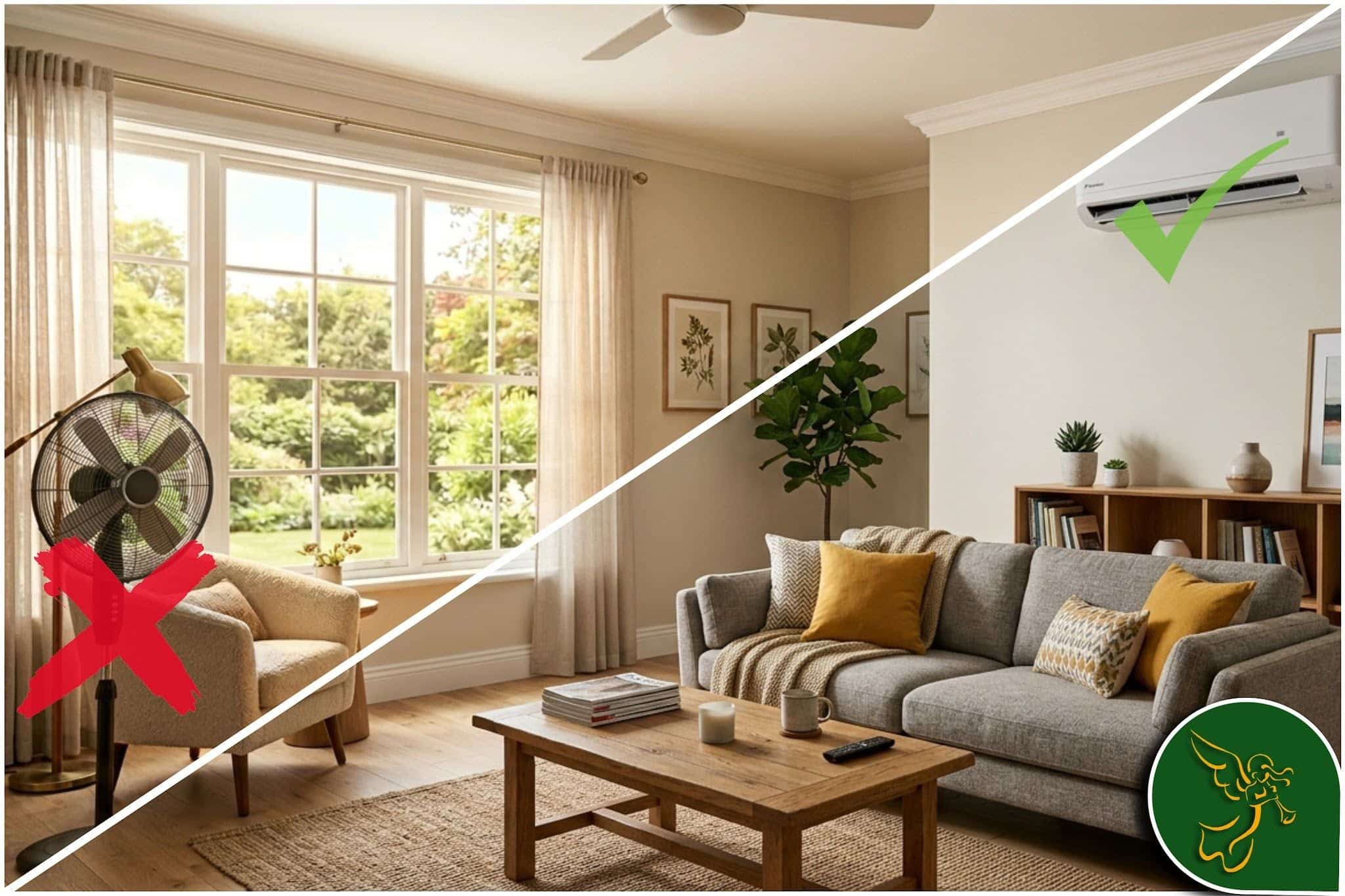
We get this call almost every week, and it usually sounds the same: "There's one room in my house I just can't keep comfortable."
It's the bonus room over the garage that bakes all summer. The rest of the house cools fine but never quite reaches the new addition. The garage someone turned into a gym, an office, or a workshop. The sunroom that's wonderful in spring and unbearable in July.
When a single space won't cooperate, there are really only two solid ways to fix it: extend your existing central air system to cover it, or install a ductless mini-split dedicated to that space. Both are legitimate. But in our experience across the Birmingham and Huntsville metros, one of them is the right answer far more often than the other — and we'd rather explain why than just sell you the bigger ticket.
Option 1: Extending Your Central Air
The instinct most homeowners have is to tie the problem room into the system they already own. Run a new duct, add a vent, maybe a return, and let the existing unit handle it. Sometimes that works. But here's what we have to check first, and where it often falls apart:
- Your existing system may not have the capacity. Central units are sized for the square footage they were installed to handle. Bolt on a new room and you're asking that same unit to cool more house than it was built for. The result isn't just a still-uncomfortable bonus room — it's a system that now struggles to keep the whole house comfortable, runs longer, and wears out faster.
- Long duct runs lose their punch. That bonus room over the garage is usually the farthest point in the house from the air handler. By the time conditioned air travels all that distance — often through a hot attic — it has lost much of its cooling power. You can feel air coming out of the vent and still have a warm room.
- These spaces are often poorly insulated. Rooms over garages, older additions, and converted garages frequently weren't built to the same insulation standard as the main house. Pumping more air at them without addressing that is like filling a bucket with a hole in it.
Extending central air makes the most sense in two situations: when you're already replacing the entire system anyway and can properly size up for the added load, or when the problem space sits close to the existing ductwork and the current unit has real capacity to spare.
Option 2: A Ductless Mini-Split
A mini-split is exactly what it sounds like — a heating and cooling system with no ductwork. There's a compact outdoor unit and one (or more) indoor "head" mounted on the wall of the room you want to condition. The two are connected by a small line set through the wall, not a network of ducts.
For a single problem space, this is usually the better tool, and here's why:
- It doesn't touch your main system. The mini-split handles that room on its own, so you're not stealing comfort from the rest of the house or overworking a unit that's already doing its job.
- You get independent control. That room gets its own thermostat and its own zone. Keep the garage gym cool while you're working out without cranking the whole house down. Heat the bonus room in winter without overheating the floor below.
- No ducts means no duct losses. The air is conditioned right there in the room, so you don't lose efficiency to long runs through a hot attic.
- It heats, too. Modern mini-splits are heat pumps, so the same unit that cools that sunroom in August keeps it warm in January — and they handle Alabama winters with no trouble.
The honest trade-offs: a mini-split puts a visible unit on your wall, which some homeowners don't love aesthetically, and if you want to condition several separate rooms, you'll need either multiple heads or a multi-zone system, which raises the cost.
What About Cost?
This is where a lot of homeowners are surprised. People assume tying into the existing system is automatically cheaper because "the unit's already there." But extending ductwork into a hard-to-reach space can mean opening walls and ceilings, long runs of new duct, and sometimes a bigger air handler to carry the load — and it still may not solve the problem.
A ductless mini-split typically ranges between $5,000–$10,000, depending on the number of unit heads and the sizing required, and for one problem room it often lands at or below the true cost of properly extending central air into that same space — without the disruption. (We'll give you exact, written pricing for your specific home and space during the evaluation — every room is a little different.)
So Which One Is Right for You?
| Lean toward a mini-split if: | Lean toward extending central air if: |
|---|---|
| You have one or two specific problem spaces. | You're already replacing the whole system and can size up correctly. |
| You're conditioning a garage conversion, addition, or sunroom. | The space is close to existing ductwork. |
| The area sits far from your air handler. | Your current unit genuinely has capacity to spare. |
| You want independent temperature control. | You prefer a completely invisible system. |
For the most common situation we see here — that hot bonus room over the garage, or a garage someone's turned into usable living space — a mini-split is usually the smarter, more affordable, and less disruptive fix. It solves the actual problem instead of asking a system that's already stretched to do even more.
If you've got a room your house just won't cool, call Perfect Service at 205-206-6091 . We'll look at the space, tell you honestly which approach fits, and give you real numbers for both — so you can make the call with all the facts in front of you. That's how we think comfort decisions should be made.
Yes. Modern ductless mini-splits are heat pumps, so the same unit cools in summer and heats in winter. They handle Alabama's relatively mild winters easily, which makes them a strong year-round solution for a single space.
A single outdoor compressor can often support multiple indoor heads in what's called a multi-zone system, letting you condition several rooms independently. The right number depends on the size and layout of the spaces, which we'll size out for your home.
No — they're known for being quiet. The loudest component is the outdoor compressor, and the indoor head runs at a low hum that most people stop noticing. That's part of why they work so well in offices and bedrooms.
Often, yes. Because you're only conditioning the room you're using, with its own thermostat and no duct losses, you avoid overcooling the whole house just to reach one space. The zoned control is where a lot of the savings come from.
It will, but it works best when the space has at least reasonable insulation. A mini-split can condition a poorly insulated garage, but improving the insulation first means a smaller unit and lower running costs. We can advise on that during the visit.