

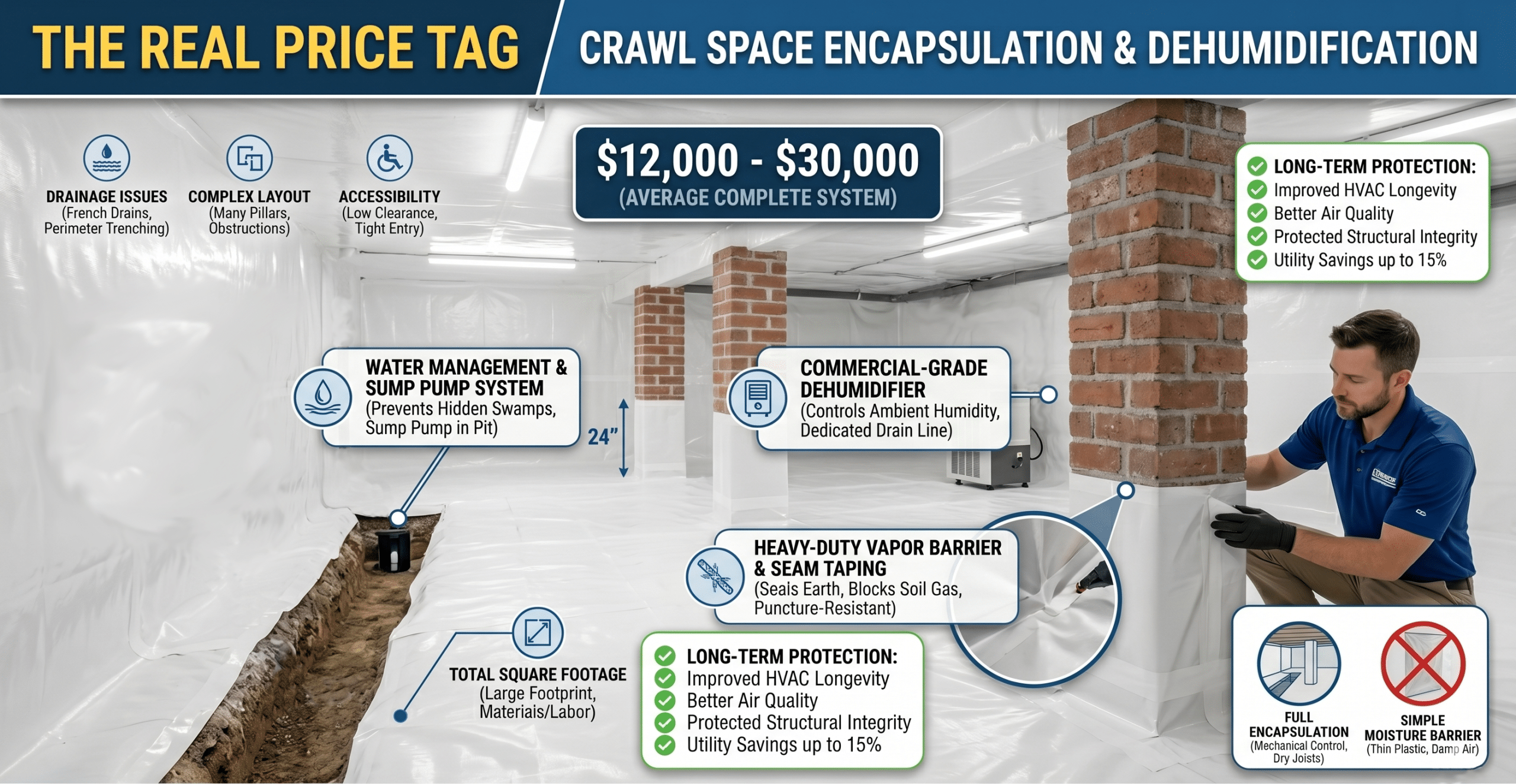
If your home has soft floors, a musty smell creeping into the living room, or active standing water under the house, you already know you have a crawl space problem. What you probably don’t know is exactly how much it is going to cost to fix it permanently.
If you have started researching online, you have likely run into vague answers, non-committal estimates, or websites telling you to "call for a quote."
Let’s skip the games and look at the actual numbers.
A professional, complete crawl space encapsulation and dehumidification system typically starts around $12,000 and can go up to $30,000 on average.
That is a significant investment. To understand why the price tag is what it is, you need to understand exactly what you are paying for, why certain components are completely non-negotiable, and what variables drive your specific price up or down.
Full Encapsulation vs. A Simple Moisture Barrier
Before breaking down the dollars, we have to draw a hard line between two very different services:
- A Simple Moisture Barrier: This is simply laying thin, loose plastic across the dirt floor. It does not include a sump pump, drainage, air sealing, or a dehumidifier. It is a low-cost, basic maintenance step that does not fix active water or severe humidity issues.
- Full Encapsulation: This is a comprehensive engineering solution. The entire space is treated like a cleanroom. It seals out the earth, permanently manages groundwater, blocks outdoor humidity, and mechanically controls the air under your home.
This article focuses strictly on the cost of a Full Encapsulation system.
The True Cost Breakdown: What Are You Actually Paying For?
When a project costs between $12,000 and $30,000, it isn’t because plastic is expensive. It is because you are buying a complete water management and environmental control system. Here is where that money goes:
1. Water Management and Sump Pump System (Mandatory)
Most homeowners need encapsulation because they have drainage or groundwater issues. If water is entering your crawl space, trapping it under or behind plastic without a way to get it out will create a subterranean swamp.
How this water is managed depends heavily on the severity of your situation:
- In Mild or Moderately Damp Cases: We don't need to charge you extra money for extensive trenching. Water naturally flows to the lowest point of the crawl space, so we install a high-capacity sump pump at that exact low point to collect and discharge groundwater out and away from your foundation.
- In Extreme Cases: If the space actively floods or has severe drainage issues, full-scale interior French drains, perimeter trenching, and deep gravel beds must be installed before any plastic goes down.
2. Premium Vapor Barrier (12 to 20+ Mil Thick)
This is not the thin construction plastic you buy at a hardware store. True encapsulation utilizes heavy-duty, puncture-resistant polyethylene sheeting. It completely covers the dirt floor, runs 100% of the way up the masonry foundation walls, and completely wraps every single structural pillar supporting your home.
3. Mechanical Sealing and Taping
This is where the bulk of the intense labor hours go. Teams must use specialized structural tape, termination strips, and polyurethane sealants to marry the heavy plastic to the concrete or brick. Every joint, seam, and pillar must be meticulously taped and sealed airtight to ensure zero moisture or soil gases can leak through.
4. Foundation Vent and Air Sealing
To control the climate under your home, you have to cut off the outside world. This step involves permanently sealing off your foundation vents and blocking outdoor air leaks, isolating the crawl space from hot, humid summer air.
5. Commercial-Grade Dehumidifier
An encapsulated crawl space acts like a sealed cooler. If any ambient humidity gets trapped inside, it has nowhere to go, turning the space into a literal incubator for microbial growth. A heavy-duty, commercial-grade dehumidifier is installed to constantly pull gallons of water out of the air and automatically pump it outside through a dedicated drain line.
Why Your Quote Might Be $14,000 vs. $28,000
Because every home is built differently, no two crawl space projects cost the exact same. Four major factors dictate where your home will fall on the pricing spectrum:
- The Severity of the Drainage Issue: As mentioned, a damp crawl space that only requires a low-point sump pump keeps costs down. A space requiring a full French drain system across the entire perimeter will push the project toward the higher end of the spectrum.
- Pillar and Obstruction Count: A wide-open crawl space is fast to seal. A home with dozens of brick or concrete pillars, low-hanging ductwork, and complex plumbing lines requires hundreds of intricate cuts, custom wrapping, and hours of tedious detail labor.
- The "Crawl" Factor (Accessibility): Working in a 4-foot-high crawl space allows a crew to move quickly. A tight, 18-inch mud crawl space dramatically slows down labor production and increases the physical difficulty of the job, which drives up the cost.
- Total Square Footage: A 2,500 sq. ft. footprint simply demands double the physical materials, tape, drainage pipe, and labor hours of a 1,200 sq. ft. home.
Why the Pump and Dehumidifier Are Not "Optional"
Homeowners frequently ask, "Can I just get the plastic sealed up the walls and skip the pump and dehumidifier to save a few thousand dollars?"
The short answer is no. Skipping these components turns a home improvement project into a home destruction project.
Without the sump pump, rising groundwater will get trapped on top of or under your new liner, leaving you with hidden standing water that you won't notice until the smell hits your living room.
Without the dehumidifier, the trapped air will stagnate. Even the best plastic cannot stop 100% of ambient humidity from migrating through concrete walls over time. The dehumidifier is the heart of the system; it is the machine that keeps the wood joists dry and stops microbial growth from developing.
The Ultimate Return on Investment
Spending $12,000 to $30,000 on a part of your house you never look at is a tough pill to swallow. However, ignoring the problem doesn't make it go away; it just makes it more expensive later when you have to pay for structural wood rot repair, floor leveling, and expensive structural remediation.
When you invest in a full encapsulation system, you are buying long-term protection:
- Improved HVAC Longevity: Your ductwork and indoor equipment live in a clean, dry, conditioned environment instead of a humid swamp, preventing premature rust and system strain.
- Protected Structural Integrity: It completely halts wood rot, sagging subfloors, and expensive structural foundation damage.
- Better Air Quality: Roughly 50% of the air you breathe on the first floor of your home comes directly out of your crawl space. Encapsulation means breathing clean, dry air instead of damp soil vapors.
- Utility Bill Savings: It helps stop the "Stack Effect" (where cold or hot, humid air is sucked from the crawl space up into your living areas), allowing homeowners to see savings up to 15% on monthly heating and cooling costs. Note: Because a high-capacity dehumidifier requires electricity to run, your exact energy savings will depend on your home's layout and how hard the system has to work.
If you are tired of dealing with musty smells, cupping hardwood floors, or standing water under your house, it’s time for a real solution. Contact us today 205-206-6091 to schedule a transparent, thorough on-site evaluation where we will map out your exact drainage and sealing needs with zero guesswork.
A regular plastic liner (moisture barrier) is just loose plastic laid on the dirt. Full encapsulation involves a commercial dehumidifier, a sump pump system, sealing all foundation vents, and meticulously taping and sealing heavy-duty material up every wall and pillar. You are paying for a complete engineered environmental control system, not just materials.
Commercial-grade dehumidifiers are highly energy-efficient, but they do consume power. While encapsulation reduces the workload on your main HVAC system (saving you up to 15% on heating and cooling), the dehumidifier's energy consumption means your net power bill savings will vary based on how much moisture the unit has to remove.
No. French drains around the entire perimeter are reserved for extreme cases with severe, active flooding. For more mild or moderately damp crawl spaces, we install a sump pump at the lowest point of the space. Because water naturally flows downward, the pump handles the incoming water perfectly without the added expense of full-scale trenching.
Any existing microbial growth must be thoroughly cleaned and treated before the crawl space can be encapsulated. Sealing moisture-damaged or compromised wood behind plastic without addressing it first will lead to hidden structural decay over time.