

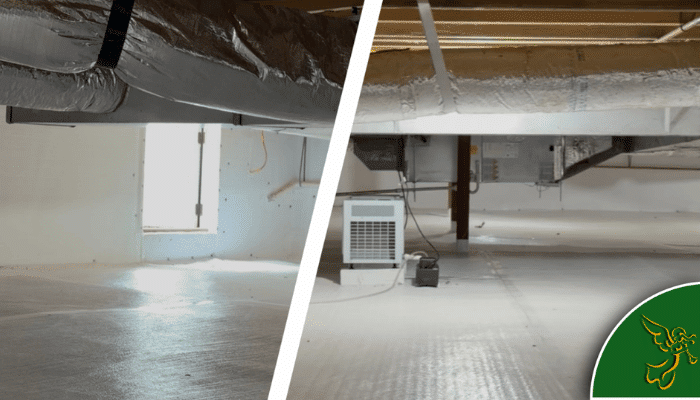
A basement dehumidifier actively removes moisture from an already-enclosed living or storage space, while crawlspace encapsulation is a full system that seals the space, installs a vapor barrier, and typically adds dehumidification on top. Basements are generally finished, conditioned spaces that just need their air dried; crawlspaces need the space itself sealed off from ground and outside moisture first. Which one your home needs comes down to which kind of space you actually have.
These two services both deal with moisture beneath or below your living space, and they're often confused. The right one for your home depends on what kind of space you actually have. Here's how to tell them apart.
Basement Dehumidifiers: For an Already-Enclosed Space
A basement is typically already a built, enclosed part of the home's structure — walls, a floor, sometimes finished living space. The moisture challenge there is usually humidity building up inside that already-sealed area, whether from groundwater seepage through the foundation, condensation, or simply being below grade.
A dedicated basement dehumidifier actively removes that moisture from the air, keeping the space dry, comfortable, and protected from mold — without needing to fundamentally change the structure of the space itself.
Crawlspace Encapsulation: Sealing the Space Itself
A crawlspace, by contrast, is often a dirt or gravel-floored, vented space that was never sealed off from the ground or outside air in the first place. Before you can manage humidity there the way you would in a basement, you generally need to seal the space itself — closing vents, installing a heavy vapor barrier across the floor and walls, and sealing seams — since ground moisture and outside humid air are actively entering through gaps a basement doesn't have.
Once that sealing is done, dehumidification is typically added on top — similar in principle to a basement dehumidifier, but only after the space itself has been properly closed off. (Our breakdown of what crawlspace encapsulation actually includes walks through each piece of that system.)
Why the Distinction Matters
Trying to dehumidify a still-vented, unsealed crawlspace the way you would a basement doesn't work well — you're fighting a constant, unaddressed source of new moisture and humid air pouring in. And treating a basement like it needs full encapsulation misunderstands that it's typically already a closed structure that just needs its air actively dried.
Which One Does Your Home Need?
If you have a basement — an enclosed, walled space below grade — a dedicated dehumidifier addressing that space's humidity is usually the right tool. If you have a crawlspace — a shorter, often vented, dirt or gravel-floored space beneath the home — encapsulation (sealing plus dehumidification) is the more complete solution.
Some homes have both a basement and a separate crawlspace area, in which case each may need its own appropriate solution.
The Bottom Line
Both services aim at the same outcome — protecting your home from moisture-related problems — but they start from different points depending on whether the space is already sealed or still open to ground and outside air.
If you're not sure which applies to your home, call Perfect Service at 205-206-6091 or contact us online. We'll assess your specific space and recommend the right solution rather than a generic one.
Common Questions About Basement and Crawlspace Moisture
Without sealing the space first, a dehumidifier is fighting a constant, unaddressed source of new moisture — which makes it far less effective and efficient than pairing it with proper sealing.
Not necessarily — it depends on how much moisture the specific basement deals with. Some are drier than others depending on grading, waterproofing, and construction.
Generally yes, since it involves sealing the space itself in addition to humidity control, while a basement dehumidifier installation is typically a more contained project.
The underlying concern — excess humidity leading to mold and structural issues — is similar, but the source and starting condition of the space differ, which is why the solutions differ too.
Generally, if you can stand upright and it has finished or semi-finished walls and flooring, it's a basement. If it's low-clearance with an open dirt or gravel floor, it's a crawlspace. We can confirm during an assessment either way.