

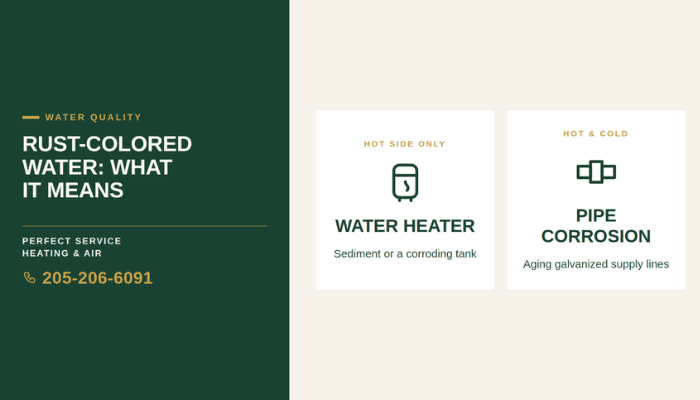
Rust-colored tap water is usually caused by corrosion inside your water heater tank, aging galvanized pipes, or occasionally a municipal water main disturbance. The quickest way to narrow it down: rust from the hot tap only points toward the water heater, while rust from both hot and cold points toward pipe corrosion. Running the tap for a few minutes helps too — a municipal disturbance often clears on its own, while internal corrosion doesn't.
Turning on the tap to rust-colored water is alarming, and understandably so. Let's walk through the most likely causes so you know what you're actually dealing with.
The First Question: Hot Water, Cold Water, or Both?
This single detail narrows things down significantly. Rust appearing only in your hot water points toward your water heater. Rust appearing in both hot and cold water points toward your home's pipes themselves — or, occasionally, a municipal source.
If It's Just the Hot Water: Your Water Heater
Inside a tank water heater, corrosion can develop over the years, particularly as the anode rod (a sacrificial component designed to corrode instead of your tank) wears down and eventually stops protecting the tank itself. Once the tank starts corroding directly, you can get rust-colored water specifically from your hot tap, since that's the water coming from the affected tank.
If It's Both Hot and Cold: Aging Pipes
Older homes, particularly those with galvanized steel pipes, can develop internal corrosion over the decades that eventually starts shedding rust into your water supply. Since this affects the pipes themselves rather than just the water heater, it shows up in both hot and cold water.
Sometimes It's Not Your Home At All
Municipal water main work, a nearby break, or other utility-side disturbances can occasionally stir up sediment in the broader water system, causing temporary discoloration that isn't actually related to your home's plumbing. If neighbors are reporting the same issue, or your utility has announced nearby work, this may be the explanation — and it often resolves on its own once the disturbance settles.
Why You Shouldn't Just Wait It Out
If the rust coloring is coming from your water heater or your pipes, it's a sign of active corrosion happening somewhere in your system, and it won't resolve itself. A water heater developing internal corrosion is one of the signs of a failing unit, and pipe corrosion tends to progress rather than improve.
What to Do
Run the affected tap for a few minutes to see if it clears — a municipal disturbance often clears this way, while an internal corrosion issue typically doesn't fully resolve. If it persists, or keeps recurring, that's your signal to have the actual source diagnosed rather than continuing to run discolored water and hoping it improves. If hard water is part of the bigger picture in your home, whole-home water treatment can also help protect your plumbing and appliances going forward.
The Bottom Line
Rust-colored water always has a real, identifiable cause — your water heater, your pipes, or occasionally the municipal supply. Figuring out which one lets you address the actual problem instead of guessing.
Call Perfect Service at 205-206-6091 or contact us online for a proper diagnosis of your rust-colored water, serving Huntsville, the Tennessee Valley, and the Birmingham metro.
Common Questions About Rust-Colored Water
It's generally advisable to avoid drinking or cooking with visibly discolored water until the cause is identified and addressed, even if the underlying issue often isn't an immediate health emergency.
Check whether the discoloration appears in the hot water only, versus both hot and cold — that's the most useful first clue.
If the cause is sediment rather than actual tank corrosion, a flush can help. If the tank itself is corroding internally, flushing won't resolve the underlying issue, and replacement may be the better path.
Generally yes — pipe corrosion tends to be progressive rather than something that improves on its own, which is why it's worth having assessed rather than just tolerated.
Older homes with original galvanized plumbing, in either area, are more prone to this kind of pipe corrosion simply due to the age of the materials involved.