

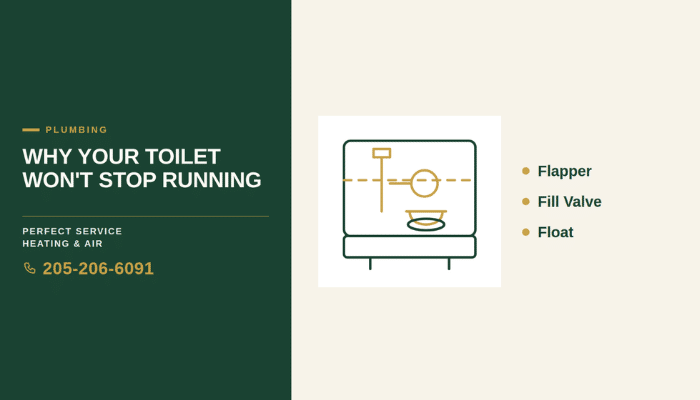
A toilet that keeps running after flushing is usually caused by a worn flapper valve that isn't sealing, a fill valve that won't shut off, or a float set too high. A running toilet can waste a surprising amount of water and add real cost to your water bill over time. The fix is often inexpensive — but it's worth diagnosing correctly so you're not just chasing the wrong part.
That faint, continuous running sound from the bathroom — sometimes for minutes at a time — is one of the most common plumbing complaints we hear, and it's usually a small part causing a surprisingly real cost. Let's walk through what's actually happening, and when a quick toilet repair is the right call.
What's Inside Your Toilet Tank
Lift the tank lid and you'll see a fairly simple mechanism: a flapper valve at the bottom that opens to release water into the bowl during a flush, a fill valve that refills the tank afterward, and a float that tells the fill valve when to stop. A running toilet almost always traces back to one of these three components not doing its job correctly.
The Most Common Culprit: A Worn Flapper
The flapper is a rubber seal that needs to fully close after each flush to keep water in the tank. Over time it can warp, crack, or accumulate mineral buildup from hard water, all of which prevent it from sealing completely. Even a small gap lets water continuously trickle from the tank into the bowl, which your fill valve then keeps trying to replace — creating that continuous running sound.
A Fill Valve That Won't Shut Off
Sometimes the fill valve itself is the problem, failing to fully stop the water flow once the tank reaches its proper level. This can result from wear or from debris interfering with the valve's mechanism.
A Float Set Too High
If the float (which tells the fill valve when to stop) is set too high, water keeps filling past the point it should, eventually overflowing into the overflow tube and running continuously — similar in sound and effect to a flapper problem, but with a different actual cause.
Why This Deserves Attention, Not Just Annoyance
A running toilet isn't just a mildly irritating sound — it can waste a significant amount of water continuously, day and night, which adds up on your water bill in a way that's easy to underestimate until you see the cost. What seems like a minor issue can be a genuinely costly one over time.
Is This a DIY Fix?
Flapper replacement is often a manageable DIY task for a comfortable homeowner — it's an inexpensive part and a fairly straightforward swap. Fill valve or float adjustments can be more involved depending on the specific mechanism, and if a straightforward flapper swap doesn't solve it, that's a sign the cause is something else worth having properly diagnosed.
The Bottom Line
A running toilet is common, usually inexpensive to fix, and genuinely worth addressing given how much water it can waste if left alone. Don't let it just become background noise in your home. And if it's not the only thing acting up, it's worth looking at your full range of plumbing needs at once — from drain cleaning to water heaters.
If the running won't stop after a flapper swap — or you'd rather have it handled right the first time — call Perfect Service at 205-206-6091 or contact us online for toilet repair, serving Huntsville, the Tennessee Valley, and the Birmingham metro.
Common Questions About a Running Toilet
A meaningful amount over time, running continuously day and night — a running toilet can waste hundreds of gallons, which is why even a seemingly minor running sound is worth addressing rather than ignoring.
Many homeowners can handle this as a straightforward DIY task — it's an inexpensive part and doesn't typically require special tools.
This pattern often still points to a flapper or fill valve issue, just one that's slowly leaking rather than constantly running — sometimes called a "phantom flush."
It can be a contributing factor, since mineral buildup from hard water can affect how well a flapper seals over time.
If a flapper replacement doesn't resolve the issue, or the mechanism looks more complex than you're comfortable with, that's the point to bring in a professional diagnosis.