

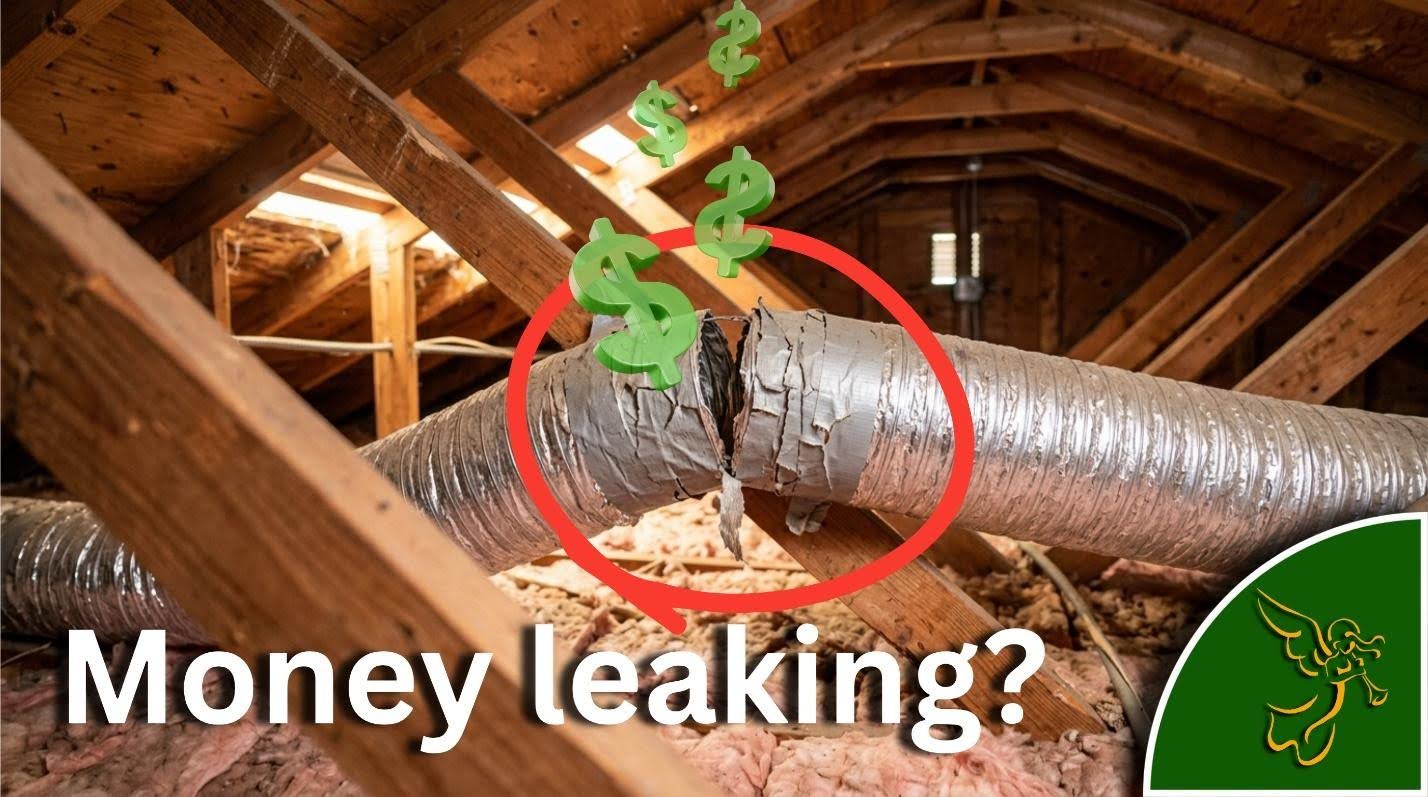
You pay your power bill to heat and cool the air inside your home. So here’s an uncomfortable question: what if a big chunk of that conditioned air never makes it to your rooms at all? When ductwork leaks — and in older Alabama homes, it very often does — you’re literally paying to cool your attic and warm your crawlspace. It’s one of the most expensive problems in a house precisely because it’s invisible: the ducts are hidden, so the waste is silent.
According to ENERGY STAR, a typical duct system loses about 20 to 30 percent of the air moving through it to leaks, holes, and poor connections. Think about that as money: up to roughly a third of what you spend on comfort, gone before it reaches you.
And because our ducts here usually run through the harshest parts of the house — blazing-hot attics and damp crawlspaces — those leaks land in exactly the worst spots.
In the Summer: You’re Cooling the Attic
Let’s start where most Alabama homeowners feel it first — the cooling season.
When supply ducts leak in a hot attic, the cold air you paid to produce escapes into a space that can hit 130 degrees, doing you absolutely no good. Your system has to run longer and longer to make up the difference, which means higher bills and more wear on the equipment.
It gets worse on the return side. When the ducts that pull air back to your system have leaks, they suck in superheated, humid, dusty attic and crawlspace air instead of your nice cool indoor air. Now your AC isn’t just losing cooling — it’s being handed hot, moisture-laden air to deal with, which makes it work even harder and can leave your home feeling sticky no matter how low you set the thermostat. During an Alabama July, that’s a system fighting a battle it can’t win.
In the winter, the same leaks drain your heat
A duct leak doesn’t take the winter off. Those same gaps and disconnected joints that bled cool air all summer now dump your heated air into unconditioned spaces. Your furnace or heat pump runs longer to keep up, certain rooms stay stubbornly cold, and your winter bills climb for heat you never actually felt.
This is the part homeowners often miss: sealing your ducts isn’t a summer fix or a winter fix. It pays you back every single month of the year.
How Leaky Ducts Cost You, Season by Season
| Topic | Summer (Cooling) | Winter (Heating) |
|---|---|---|
| What's lost | Cooled air escapes into the hot attic/crawlspace | Heated air escapes into the same unconditioned spaces |
| The hidden insult | Return leaks pull in hot, humid, dusty air | Return leaks pull in cold air |
| What you notice | High bills, sticky rooms, AC that won’t catch up | High bills, cold rooms, furnace running constantly |
| The toll on equipment | Longer runtimes and added strain year-round | Longer runtimes and added strain year-round |
Where Ducts Usually Leak
Leaks tend to show up in predictable places: at the connections coming off the air handler, at joints and “takeoffs” where ducts branch, at the boots behind your registers, and anywhere old cloth tape or dried-out mastic has crumbled and let go. In a lot of older homes, we also find flex duct that’s been crushed, kinked, or even pulled apart entirely. The runs in attics and crawlspaces are the usual suspects — out of sight, and rarely checked.
Signs Your Ducts Might Be Leaking
- Energy bills that feel too high for how comfortable the house actually is
- Rooms that never quite get comfortable no matter what the thermostat says
- Excessive dust, since leaks pull in dirty air from attics and crawlspaces
- Weak or uneven airflow at some vents compared to others
- Ducts you can see that are visibly torn, sagging, or disconnected
- An attic or crawlspace that feels strangely conditioned (a sign your air is ending up there)
The Fix — and the Payback
The good news is that this is a fixable, high-return problem. A proper duct evaluation finds where the leaks are, and sealing them with the right materials — professional-grade mastic and sealing methods, not the hardware-store “duct tape” that ironically dries out and fails — closes the gaps for good. In unconditioned spaces, properly insulating the ducts on top of sealing them keeps even more of your money inside the system.
Here’s the honest part: not every home needs a full reseal, and we’ll tell you if yours doesn’t. But when ducts are leaking, sealing them is one of the rare upgrades that lowers your bills in both seasons, makes your home more comfortable, cuts down on dust, and eases the strain on your equipment so it lasts longer. You’re not buying something new — you’re recovering air you’re already paying for.
If your bills don’t match your comfort, or you’ve got rooms that just won’t cooperate, call Perfect Service at 205-206-6091 . We’ll inspect your duct system, show you what we find, and give you straight answers on whether sealing makes sense for your home. Keeping the air you paid for inside your house is about as Guardian as it gets.
Common Questions About Leaky Ductwork
Industry figures put typical duct losses around 20 to 30 percent of the air your system moves. Translated to your bill, that can be a meaningful slice of your heating and cooling costs every month — money spent conditioning your attic and crawlspace instead of your living room.
Ironically, no. Standard cloth “duct tape” dries out and peels off, often within a year or two. Lasting duct sealing uses mastic or specialized materials applied to the connections and seams — which is why a proper repair holds up where a quick tape job doesn’t.
Usually at connections off the air handler, at branch joints and takeoffs, at the boots behind registers, and anywhere old tape or mastic has failed. The runs through attics and crawlspaces are the most common — and least inspected — culprits.
Yes. The same leaks that lose cooling in summer lose heat in winter. Sealing is a true yearround improvement, which is part of what makes it such a worthwhile fix.
The warning signs — high bills, uneven rooms, heavy dust, weak airflow — are good clues, but the only way to know for certain is a professional inspection that can pinpoint where and how much your system is leaking.