

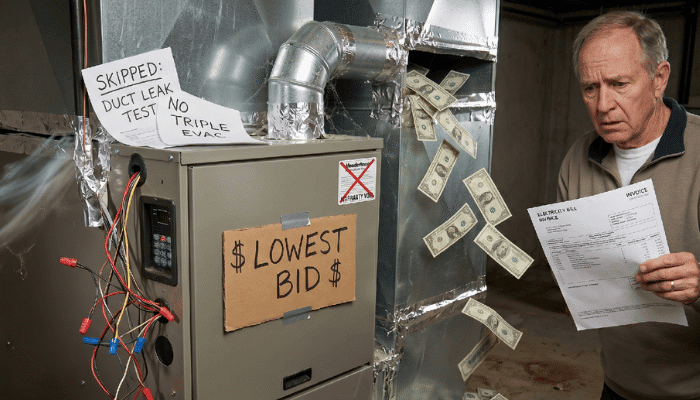
When replacing an HVAC system, accepting the lowest bid often leads to severe long-term financial consequences. Low-cost contractors cut critical corners during the installation process—skipping load calculations, ignoring failing ductwork, and using inferior materials. While the upfront savings are appealing, homeowners frequently pay double down the road due to chronic system breakdowns, inflated monthly utility bills, voided manufacturer warranties, and a system lifespan shortened by up to 50%. Investing in quality installation craftsmanship is the only true way to protect your home and wallet.
We all love a good deal. When you're facing a major home improvement expense like replacing a heating and air conditioning system, it’s completely natural to shop around and compare quotes. However, in the mechanical trades, an exceptionally low-ball price shouldn't be celebrated—it should be a major red flag.
An HVAC unit is not a plug-and-play appliance like a refrigerator or a washing machine. It is a complex mechanical system shipped from the factory only half-assembled. The field installation accounts for more than 80% of the equipment's ultimate efficiency, reliability, and lifespan. When a contractor gives a baseline price, they are matching that price with baseline shortcuts.
The Shortcuts: Where Cheap Bids Save Money
1. "Rule-of-Thumb" Sizing vs. Manual J Calculations
A quality contractor will perform a thorough Manual J load calculation to evaluate your home’s insulation, window square footage, orientation to the sun, and layout. Cheap installers completely skip this step, guessing the system size based strictly on total square footage. An improperly sized unit will short-cycle constantly, destroying its components and leaving your home humid and uncomfortable.
2. Slapping New Equipment onto Failing Ductwork
A brand-new, high-efficiency heating and air system attached to an old, restrictive, or leaky duct system is an absolute waste of money. Low-bid contractors rarely inspect the existing ductwork for proper static pressure or air leaks. They swap the unit out as fast as possible, leaving your new system to suffocate on restrictive, dusty, or disconnected ducts.
3. Cutting Corners on Installation Mechanics
Proper installation requires time, precision, and expensive specialized tools. To pull a proper vacuum on a refrigerant line to clear out moisture and non-condensables, a technician must let a vacuum pump run until it hits a precise micron level. Cheap installers often rush this process ("triple-evacuation? No time for that!"), leaving microscopic moisture inside the lines that mixes with oil to create a destructive acid, eating your compressor from the inside out.
The Real Financial Impact
The operational quality of your HVAC unit is directly tied to the day it was installed. A poorly installed system can lose up to 30% of its rated heating and cooling capacity on day one. When you accept the lowest bid, you are often unknowingly paying for:
- Inflated Energy Bills: If the system is struggling against bad airflow or a poor refrigerant charge, it has to run twice as long to cool the house, spiking your power bill.
- Frequent Component Failures: Rushed installations lead to burnt-out capacitors, failed TXV valves, and dead compressors within the first few years.
- Voided Warranties: Major manufacturers like Trane, Carrier, and Lennox require systems to be installed according to strict guidelines by licensed professionals. If an uncertified or careless installer takes shortcuts, the manufacturer can deny your parts warranty claims.
Even the most expensive, top-tier HVAC equipment will fail prematurely, break down constantly, and run inefficiently if it is hooked up to leaky ducts, charged with the wrong amount of refrigerant, or sized incorrectly. Conversely, a mid-grade system installed with flawless craftsmanship will easily outlive and outperform it.
A comprehensive estimate should explicitly detail a Manual J load calculation, an inspection/balancing of the duct system, the replacement of the outdoor pad, a new digital thermostat, a new electrical disconnect box, a comprehensive warranty on labor, and the pull of a certified vacuum measured in microns.
Common signs of a subpar installation include highly uneven temperatures between rooms, excessive noise or vibration when the unit kicks on, high indoor humidity levels, a system that turns on and off every few minutes (short-cycling), or recurring refrigerant leaks.
Rarely. If a bid is significantly lower than competing offers, the company is likely uninsured, using uncertified laborers, skipping local building permits, or planning to disappear when you try to call them for warranty service next year. The upfront savings are quickly erased by the cost of fixing their mistakes.