

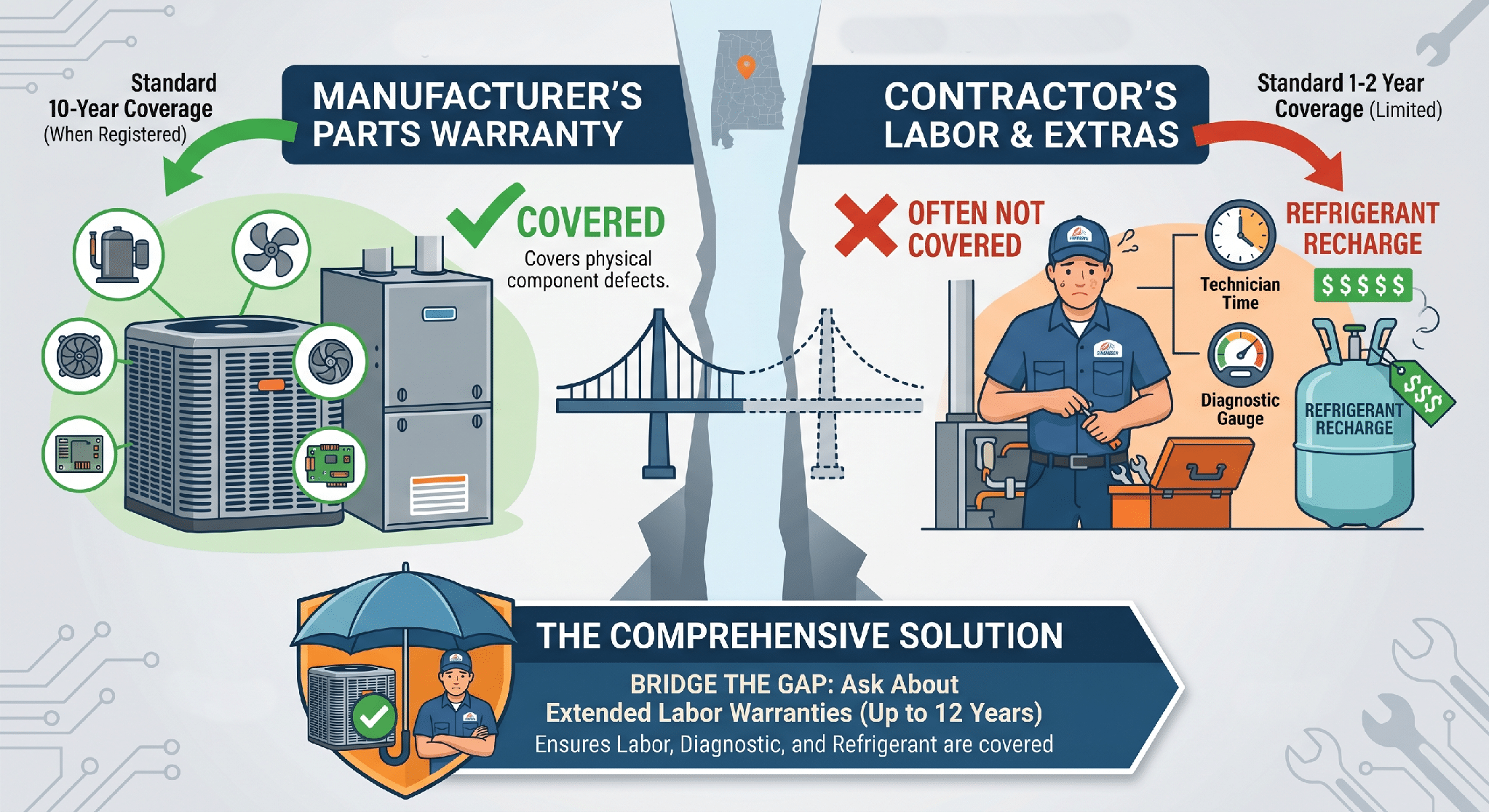
Most new HVAC systems in Alabama come with a manufacturer’s parts warranty, but many homeowners are surprised to find that these plans do not cover the cost of the technician’s time or the refrigerant required for a repair. Understanding the difference between Equipment Protection and Workmanship Protection is the key to avoiding unexpected bills three, five, or even ten years down the road.
When you invest in a new system in Birmingham, Hoover, or Vestavia Hills, you are likely receiving a 10-year parts warranty. However, a "part" is only one-half of a repair. In this guide, we break down how HVAC warranties actually work and what a "comprehensive" protection plan should look like.
The Three Layers of HVAC Protection
1. The Manufacturer’s Parts Warranty
This is the standard coverage provided by brands like Trane, Rheem, or Carrier.
- The Coverage: Usually 5 to 10 years (if the unit is registered). It covers the physical component if it fails due to a factory defect.
- The Gap: It almost never covers Labor, Refrigerant, or Diagnostic Fees. If a $1,000 part fails in Year 6, the part is free, but you could still pay $600–$900 in labor to have it installed.
2. The Contractor’s Labor Warranty
Since the manufacturer didn't install the unit, they don't cover the labor to fix it. This protection must come from the installing company.
- Standard Industry Labor: Most contractors in Central Alabama offer a 1-year or 2-year labor warranty.
- Extended Labor: Some contractors offer 10-year or even 12-year labor warranties. This ensures that both the part and the technician’s time are covered for the majority of the system's life.
3. The "Consumables" Factor (Refrigerant)
One of the largest "hidden" costs in HVAC repair is refrigerant. Many standard warranties—even some extended labor plans—exclude the cost of the "gas" needed to recharge a system after a leak repair. In the Alabama heat, a full refrigerant recharge can cost hundreds (or even thousands) of dollars. Always ask if your protection plan is Comprehensive (including refrigerant) or Limited.
Warranty Standards Comparison
| Feature | Standard "Box" Coverage | Comprehensive Protection |
|---|---|---|
| Parts | 5 – 10 Years | Up to 12 Years |
| Labor | 1 – 2 Years | Up to 12 Years |
| Refrigerant | Almost Never Covered | Often Included in Elite Plans |
| Emergency Fees | Usually Extra (Overtime) | Often Waived by Elite Contractor |
The Neutral Truth: A 12-year labor warranty is the current "ceiling" for protection in Alabama. Because the average lifespan of a system in our climate is 10 to 12 years, this level of coverage effectively eliminates repair costs for the entire useful life of the equipment.
The Connection: Installation Quality and Long-Term Reliability
Why do warranty lengths vary so much between contractors in Leeds, Moody, or Springville?
- Risk Management: A contractor is only willing to guarantee labor for 12 years if they are confident the system was installed correctly on Day 1. Poorly installed units—with leaky ductwork or incorrect refrigerant charges—fail more often.
- Expert Oversight: When evaluating a company, look for those with a Master-Led Training Culture. A company that invests heavily in its technicians is often the only one willing to take on the financial risk of a long-term labor guarantee.
Most manufacturers and third-party insurers stop at 10 years. Extending to 12 years requires a high level of confidence in the installation standards and the technical skill of the team. It is currently the most comprehensive protection level available in the Alabama market.
This varies by plan. Many manufacturer warranties "step down" to a basic 5-year term if the home changes owners. However, some high-end extended labor warranties are fully transferable to the new homeowner, which can be a significant selling point if you list your home in Hoover or Trussville.
It depends on your plans for the home. If you plan on moving in two years, a standard warranty may be sufficient. But if this is your "forever home," locking in 12 years of $0 repairs provides a level of financial predictability that a 1-year labor warranty cannot match.