

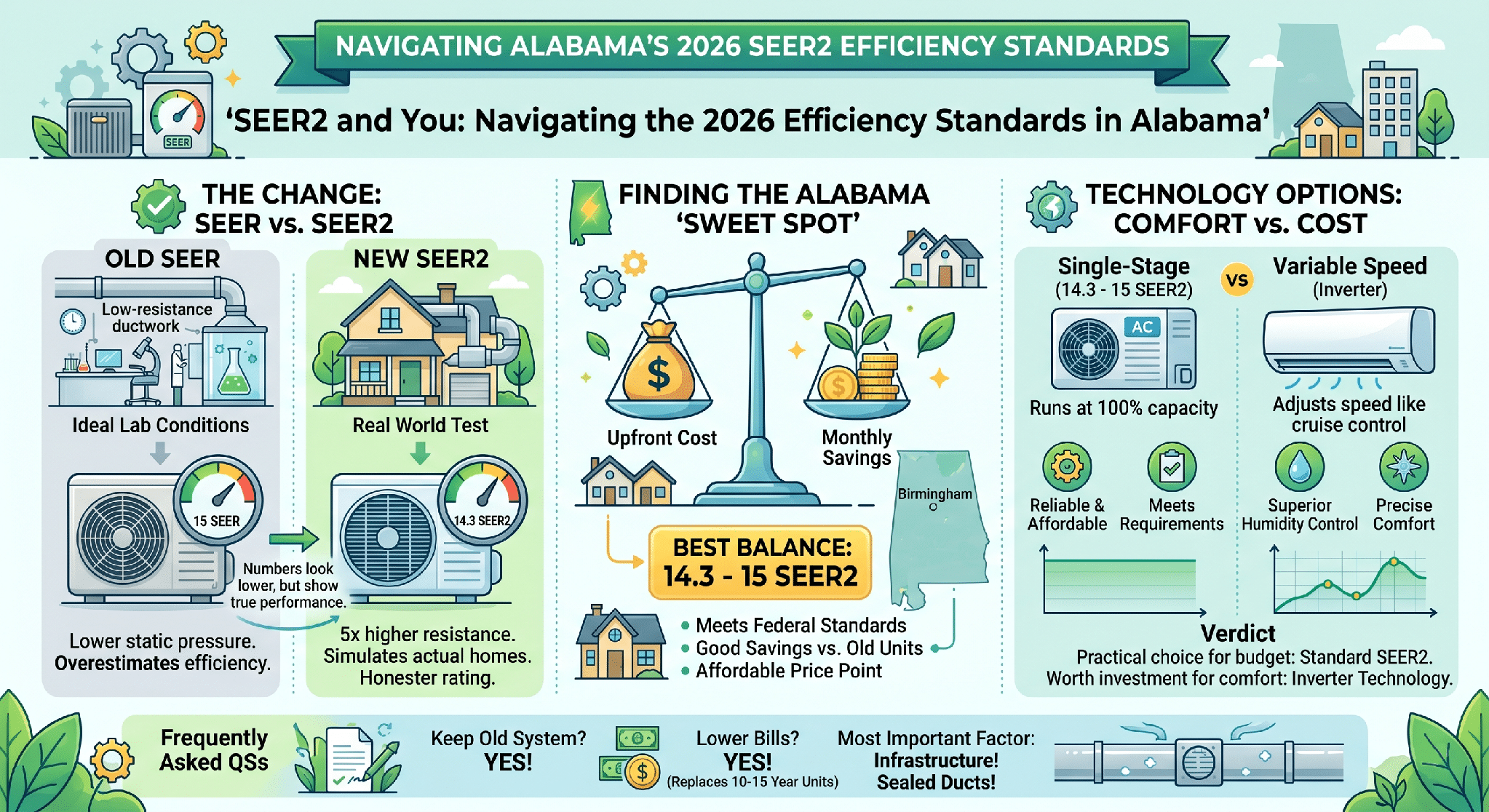
In 2026, the minimum efficiency for a new central air conditioner installed in Alabama is 14.3 SEER2 — the standard for the DOE's Southeast region — which is roughly equivalent to an old 15 SEER rating. SEER2 replaced the older SEER metric to measure efficiency under more realistic, real-world duct conditions, so the numbers look lower even though the equipment isn't any weaker. For most Alabama homes, systems in the 14.3–15 SEER2 range hit the sweet spot between upfront cost and monthly energy savings.
If you've seen new energy labels in Birmingham, Hoover, or Vestavia Hills, you've likely noticed the numbers changed. Understanding SEER2 isn't about memorizing regulations — it's about knowing how much cooling you get for every dollar you pay the electric company.
SEER VS. SEER2: Why the Change?
The Department of Energy updated its testing standards because the old SEER ratings were based on ideal lab conditions that rarely matched a real home.
- The "real world" test: SEER2 testing uses five times the external static pressure to simulate the resistance of actual ductwork.
- The math: Because the new test is harder, SEER2 numbers look lower than old SEER numbers — an old 15 SEER is roughly equivalent to a new 14.3 SEER2.
- The benefit: You get a more honest prediction of how the unit will actually perform in your home.
Efficiency as a Defense Against Rising Rates
As utility companies in Central Alabama keep adjusting their kilowatt-hour rates upward, a higher efficiency rating is a defensive strategy.
- Neutralizing increases: If rates rise 5% but your new 14.3 SEER2 system is 10–15% more efficient than your old unit, you've effectively cancelled out that hike and kept your budget predictable.
- The sweet spot: For most homeowners, systems in the 14.3 to 15 SEER2 range offer the best balance — meeting the federal requirement and delivering modern efficiency without the big price jump of ultra-high-efficiency inverter technology. That balance is worth talking through when you're pricing a new system.
The Truth About Inverters: Comfort Vs. Cost
You may hear that variable-speed or "inverter" systems pay for themselves in energy savings. They are the most efficient units on the market — but the decision to invest in one should be based on comfort, not just a lower power bill.
| Technology Type | How It Performs | The Primary Benefit |
|---|---|---|
| Single-Stage (14.3–15 SEER2) |
Runs at 100% capacity whenever it's on | Affordable, reliable, and meets all current standards |
| Variable Speed (Inverter) |
Adjusts its speed continuously, like cruise control | Superior humidity control and precise, even comfort |
The neutral verdict: If you struggle with sticky indoor air or hot spots, variable-speed technology is worth it for the comfort alone. If your main goal is a reliable, energy-efficient replacement, a standard 14.3 to 15 SEER2 system is the practical choice for the Alabama climate.
One More 2026 Change: The Refrigerant Switch
While you're comparing efficiency numbers, know that the industry also moved to new low-GWP refrigerants (R-454B and R-32) for new equipment, phasing out the old R-410A. It doesn't change your SEER2 decision, but it's worth understanding before you buy, since it affects long-term serviceability — we break it down in what R-454B means for your next unit.
Getting the Efficiency You Pay For
A high SEER2 number only delivers if the rest of the system supports it. Before you commit to a rating, it's worth having your ductwork, airflow, and sizing evaluated as part of any AC replacement — and keeping the system tuned with regular maintenance so it holds that efficiency over time.
Thinking about a new system and not sure which SEER2 rating fits your home and budget? Call Perfect Service at 205-206-6091 or contact us online and we'll help you find the right balance.
Common Questions About SEER2 Standards
No. Federal regulations only apply to the installation of new equipment. You can continue to run and repair your existing system in Cahaba Heights or Brook Highland regardless of its efficiency rating.
If you are replacing a system that is 10–15 years old (which likely had an original rating of 10 or 12 SEER), you will see a noticeable decrease in energy consumption. However, the "real-world" savings depend on your home's insulation, ductwork health, and thermostat habits.
infrastructure. A 20 SEER2 unit attached to leaky, undersized ductwork will perform like a 10 SEER unit. When evaluating a quote, ensure the contractor is assessing your entire home’s "breathability" to ensure you actually get the efficiency you are paying for.