

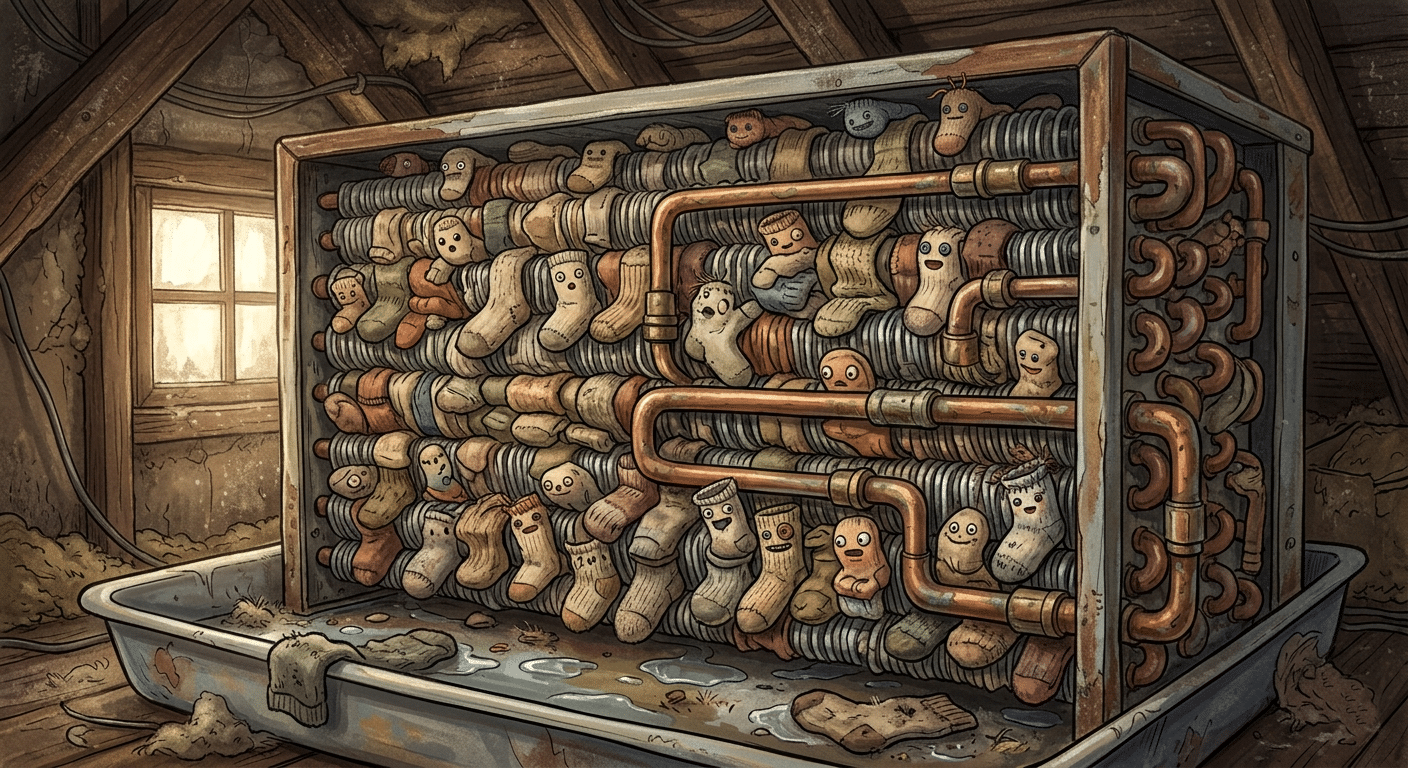
"Dirty Sock Syndrome" happens when moisture, dust, and debris build up on your indoor evaporator coil, creating a breeding ground for odor-causing microbial growth and bacteria. The fastest way to fix it is by changing your air filter, clearing your condensate drain line, and having a professional clean the evaporator coil.
So often this time of year, we hear customers say their air conditioner smells like "dirty socks." And while dirty socks are rarely to blame, we understand the problem completely.
"A lot of things can cause it," said Terry Fendley, dispatcher for Perfect Service Heating & Air. "Cats, dogs, litter boxes, the cleanliness of somebody's house — all of it can affect odors in the house. Are they changing filters on a regular basis? Are they not using a filter that's trapping all the bacteria? All of that has to be considered."
When moisture, dust, and debris collect on your indoor evaporator coil, they create the perfect breeding ground for odor-producing mold, bacteria, and fungus — and the results can be miserable. Instead of just fixing the problem after the fact, experienced technicians like Fendley would rather keep you ahead of it.
When moisture, dust, and debris collect on your indoor evaporator coil, they create the perfect breeding ground for odor-producing mold, bacteria, and fungus — and the results can be miserable. Instead of just fixing the problem after the fact, experienced technicians like Fendley would rather keep you ahead of it.
Reasons for That Smell
Moisture buildup: As your AC pulls humidity from the air, condensation gathers on the evaporator coil. If it doesn't drain properly, it lingers.
Trapped debris: Household dust, pet dander, and other particles bypass your air filter and settle on the damp coil, providing "food" for bacteria.
The "sock" smell: When the unit cycles on and off, the temperature swings cause these microorganisms to decompose and release a sour, musty odor that gets pumped into your home.
The First Steps Towards Fixing It
Change the air filter: Start by checking and replacing your HVAC air filter. A dirty or clogged filter worsens airflow and traps more debris on the coil.
Clean the evaporator coil: The root cause of the smell is a dirty coil. You can buy a specialized no-rinse evaporator coil cleaner to spray on the coils, though heavy buildup usually requires a professional cleaning.
Clear the condensate drain line: Make sure your AC drain line isn't clogged, which lets water pool in the system and promotes bacterial growth.
Schedule professional maintenance: A Perfect Service technician can safely deep-clean the coil, blower wheel, and drain pan and sanitize the system to keep the odor from returning.
The Steps to Prevent It
To keep "Dirty Sock Syndrome" from coming back, build in a few simple upgrades and habits:
Change filters regularly: Replace or wash your filters every 1 to 3 months.
Install a UV light: An HVAC UV light installed near your evaporator coil can kill mold and bacteria before they take hold.
Control household humidity: If you live in a particularly damp environment or a humid area like Clay, AL, a whole-home dehumidifier can keep moisture levels in check and starve mold of the conditions it needs.
Expert Guidance
Beyond the obvious fixes, be conscious of the odors and irritants that feed the problem.
"I've been to houses where the cat's litter box was kept right next to the returns," Fendley said. "I've seen it literally caked up on the evaporator coil like concrete. The simplest solution there is to move that litter box. That's one of our goals at Perfect Service — to give you guidance that will make your life easier."
Still Smelling It? Let's Clear It at the Source
If the odor won't go away after a fresh filter, the coil most likely needs a professional deep clean — and that's a quick job for our team. Call Perfect Service at 205-206-6091 or schedule a visit online, and we'll get your system clean, sanitized, and smelling right again.
The smell comes from microorganisms—like microbial growth, bacteria, and fungus—that breed on your indoor evaporator coil. When moisture, dust, and debris collect on the coil, these microorganisms feed and decompose, releasing a sour, musty odor into your home.
Yes. Pet dander, hair, and nearby litter boxes can severely impact your indoor air quality. If a litter box is kept near an air return, the dust and bacteria can bypass the filter and cake onto the evaporator coil, providing a major food source for odor-causing bacteria.
Start by replacing your HVAC air filter to improve airflow and stop new debris from entering the system. Next, make sure your condensate drain line isn't clogged. The actual source of the odor (the dirty coil) needs to be cleaned, which can be done with a specialized no-rinse coil cleaner or by scheduling a professional deep clean.
Prevention comes down to maintaining a clean, dry environment inside your HVAC system. You should change or wash your air filters every 1 to 3 months, install an HVAC UV light near the evaporator coil to neutralize bacteria, consider a whole-home dehumidifier, and keep strong odor sources (like litter boxes) away from your air returns.