

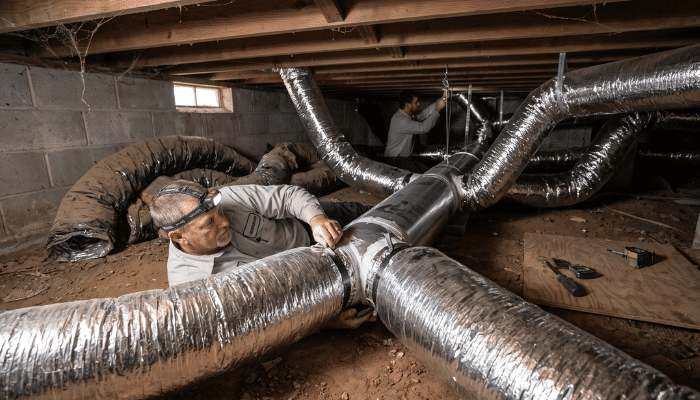
A total, professional residential ductwork replacement in North and Central Alabama typically ranges from $12,000 to $18,000+. The final investment depends heavily on the size of the home, system engineering requirements, whether custom sheet metal fabrication is needed, and physical accessibility challenges like tight crawlspaces or attics.
When replacing a home heating and air conditioning system, conversations naturally focus on the outdoor condenser or the indoor air handler. However, those components are simply the engines. The ductwork is the fuel delivery system.
Attaching a brand-new, high-efficiency system to old, collapsed, leaking, or poorly engineered ductwork is one of the fastest ways to compromise an HVAC investment. A true, code-compliant, high-performance re-duct is a major residential construction project. The final price tag depends heavily on a specific set of variables unique to every home's architecture, from Birmingham to Huntsville.
Key Factors That Dictate Alabama Ductwork Replacement Costs
1. Material Choices: Flex vs. Hard Pipe
There is a common misconception that a high-quality system requires 100% metal piping. In reality, material choices are dictated by application rather than an automatic "upgrade" path.
Flex Duct (The Industry Standard): In the vast majority of Alabama homes, flexible ductwork is utilized for individual branch runs. It is cost-effective and highly efficient when properly supported, strapped, and tensioned. From a pure performance or efficiency standpoint, justifying the massive added expense of hard pipe over flex is rarely necessary.
Hard Pipe (When Necessary): Rigid sheet metal is used based on architectural necessity rather than preference. If a home was originally engineered with a specific hard pipe layout, if structural clearances are exceptionally tight, or if the layout requires rigid materials to move air properly over long distances, going back with hard pipe may be the only realistic option — including high-static setups like mobile homes.
2. Trunk Line Engineering (Duct Board vs. Metal)
The trunk line acts as the main highway for air leaving the indoor unit. How this highway is constructed changes labor and material costs significantly:
Prefab vs. Custom Fabrication: A major cost driver is whether a contractor can use standard, off-the-shelf trunk line components, or if a fabrication shop must meticulously layout, cut, and bend custom sheet metal fittings by hand to match a unique floor plan.
Round vs. Square: Square trunk lines optimize air velocity and preserve headroom in tight spaces, but they require substantial custom fabrication compared to standard round pipe.
3. Insulation Strategies (Inside vs. Outside)
In the deep South, condensation is the ultimate enemy of ductwork. If bare metal meets 130°F attic air, it sweats—leading to damaged sheetrock and moisture issues.
Acoustic Liner (Insulated Inside): Insulating the inside of a metal trunk line absorbs the sound of rushing air and protects the insulation from external damage. However, it requires highly precise initial sizing so the internal lining does not restrict airflow metrics.
Duct Wrap (Insulated Outside): Wrapping the entire exterior of a metal system with high-R-value fiberglass insulation and sealing every single joint with mastic tape is highly effective, though it demands significant installation time and precision.
4. The Physical Environment (Attic, Crawlspace, or Basement)
The environment where technicians must work directly dictates the speed and difficulty of the installation.
The 10-Inch Crawlspace vs. 3-Foot Crawlspace: Squeezing into a brutal 10-inch dirt crawlspace to pull new lines and hang trunk lines is an agonizingly slow, labor-intensive process. A 3-foot crawlspace or a wide-open basement where installers can stand upright allows the job to move much faster.
The Alabama Attic: Working in a pitch-black, joist-constructed attic where one wrong step can cause structural ceiling damage requires extreme caution and strict safety protocols, naturally increasing labor hours — the same conditions that make proper attic insulation worth addressing alongside a re-duct.
5. System Layout & Design Metrics
Every twist, turn, and branch in a duct system introduces friction, which increases static pressure and works against the HVAC unit. Designing a system that breathes properly requires careful calculation:
Trunk Line Length & Run Count: The total length of the main trunk line and the number of individual branch runs (supply vents) delivering air to individual rooms directly scale the material and labor requirements.
Run Lengths: Delivering air 10 feet from a trunk line is straightforward; engineering a branch run to perfectly satisfy a room 45 feet away requires precise balancing.
Single System vs. Multi-System vs. Zoning: Homes utilizing multiple HVAC units, or those incorporating complex motorized zoning systems with automatic dampers directing airflow to different zones, carry a much higher level of engineering and installation complexity.
If you're weighing a re-duct alongside a system replacement, call 205-206-6091 to get an on-site assessment of your specific layout.
No. More returns are not automatically better. A professional contractor will typically only install multiple returns if the architectural layout demands it, or if they are matching an existing multi-return configuration. Unnecessary returns add maintenance hurdles; they either require managing a large number of filters throughout the house, or they force the installation of a single media filter directly at the indoor unit. Unless a homeowner wants to climb into a hot attic or crawl under the house just to change a standard air filter, a properly sized single or dual return system is usually the most practical, user-friendly choice.
Not necessarily. Flexible ductwork is the industry standard for individual branch runs because it is cost-effective, efficient, and delivers excellent airflow when properly tensioned and supported. Hard pipe requires significant labor and custom fabrication and is generally only used when tight clearances or specific structural engineering requirements make it a necessity.
Yes, as long as the existing ductwork is properly sized, well-insulated, and in good structural condition. A professional contractor will thoroughly inspect the existing ductwork to determine its condition and usability on a new system. However, if the old ductwork is leaky, restricted, or deteriorating, reusing it will force the new HVAC system's blower motor to work twice as hard—drastically reducing your energy efficiency and shortening the lifespan of your new equipment.